
Mind puzzles for adults : A Smarter Way to Relax, Refocus, and Think Deeply

Mind Puzzles for Adults: A Smart Way to Sharpen Focus, Reduce Stress, and Reclaim Your Thinking Time
In a world built on constant notifications, endless scrolling, and shrinking attention spans, the adult brain is under pressure. We’re expected to stay sharp, creative, and emotionally balanced—yet we rarely give our minds the space to actually think.
That’s where Mind puzzles for adults. come in.
Far from being childish games or idle distractions, modern mind puzzles are powerful tools for focus, mental clarity, and even stress relief. Whether it’s a complex jigsaw, a visual riddle, or a logic-based challenge, these puzzles offer adults something increasingly rare: deep, uninterrupted concentration.
This guide explores why mind puzzles are so effective for adults, how they support cognitive health, and how to choose puzzles that genuinely challenge—and satisfy—the adult mind.
Why the Adult Brain Craves Mental Challenges
Unlike children, adults don’t need stimulation for development—we need it for maintenance.
As we age, the brain naturally seeks efficiency. Without regular challenge, neural pathways weaken, attention fragments, and problem-solving becomes reactive instead of intentional.
Mind puzzles help counter this by:
Activating multiple cognitive regions at once
Encouraging pattern recognition and spatial reasoning
Strengthening memory through repetition and recall
Creating a focused mental state similar to meditation
This combination makes puzzles uniquely effective. They’re demanding without being overwhelming—and absorbing without being passive.
The Psychology Behind Mind Puzzles for Adults
When you work through a puzzle, your brain releases dopamine—the same chemical associated with motivation and reward. But unlike social media dopamine spikes (which are short-lived and addictive), puzzle-based dopamine is earned gradually through effort and progress. Platforms like Cogzart.in offer thoughtfully designed puzzles that enhance this rewarding experience while promoting relaxation and mental engagement.
This leads to:
Sustained engagement instead of distraction
A sense of accomplishment rather than exhaustion
Improved emotional regulation and patience
It’s also why many adults describe puzzle-solving as “calming but stimulating” at the same time—a rare balance.

Different Types of Mind Puzzles (And What They Train)
Not all puzzles challenge the brain in the same way. Choosing the right type matters.
1. Jigsaw Puzzles
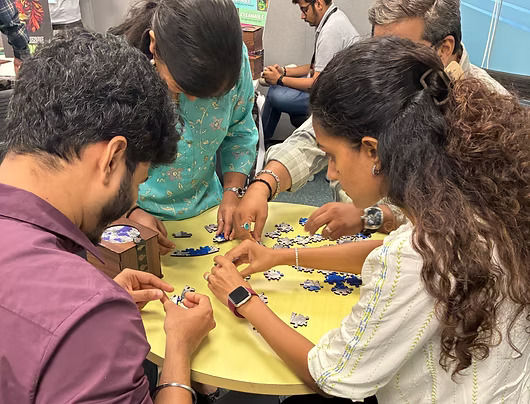
Jigsaws train spatial awareness, visual memory, and long-term focus. Complex designs, abstract imagery, and adult-oriented themes require sustained attention and strategic thinking.
2. Logic & Reasoning Puzzles
These strengthen analytical thinking and decision-making. Ideal for adults who enjoy structured problem-solving and step-by-step challenges.
3. Visual Illusion & Pattern Puzzles
Perfect for creative thinkers, these puzzles engage perception, adaptability, and non-linear reasoning.
4. Themed Concept Puzzles
Narrative-driven or concept-based puzzles engage emotional intelligence and imagination alongside logic—creating a deeper, more immersive experience.
High-quality mind puzzles for adults often blend several of these elements, making them mentally rich rather than repetitive.
Mind Puzzles as a Tool for Stress Relief
Stress isn’t just emotional—it’s cognitive.
When the mind is overloaded with unfinished tasks and digital noise, it struggles to rest. Puzzles provide a controlled mental environment with clear boundaries: one problem, one goal, one moment at a time.
This helps:
Lower cortisol levels
Reduce anxious thought loops
Encourage mindfulness without forcing stillness
Many adults find that 20–30 minutes with a challenging puzzle is more restorative than passive activities like watching TV or scrolling online.
What to Look for in Truly Adult Mind Puzzles
Not every puzzle marketed to adults actually respects adult intelligence.
When choosing mind puzzles, look for:
Complexity without gimmicks
Sophisticated visual design
Meaningful challenge, not just time-filling
A sense of progression and payoff
Some puzzle collections are specifically designed for mature minds, offering intricate artwork, provocative themes, and difficulty levels that reward patience and persistence. For example, thoughtfully designed adult puzzle collections like those explored in this guide to premium puzzle experiences demonstrate how puzzles can be both mentally demanding and visually engaging without feeling juvenile or simplistic.
Why Mind Puzzles Are a Long-Term Investment in Mental Health
Unlike apps or trends, puzzles don’t rely on novelty. Their value compounds over time.
Regular engagement with mind puzzles for adults has been linked to:
Improved memory retention
Slower cognitive decline
Better problem-solving under pressure
Increased tolerance for complexity and ambiguity
In short, puzzles train the mind not just to think—but to stay with a problem until it’s solved. That skill alone is becoming increasingly rare.
Final Thoughts: Thinking Is a Skill Worth Protecting
Mind puzzles aren’t about killing time. They’re about reclaiming it.
For adults navigating demanding careers, creative burnout, or constant digital noise, puzzles offer something quietly radical: a space where thinking deeply is the point—not a byproduct.
Choosing the right mind puzzles for adults means choosing focus over frenzy, depth over distraction, and satisfaction over stimulation.
And that’s a challenge worth taking seriously.
Citations:
National Institutes of Health (NIH)Cognitive Training and Brain Healthhttps://www.ncbi.nlm.nih.gov/pmc/articles/PMC6209861/
University of California, Berkeley – Greater Good Science CenterHow Focused Attention Activities Reduce Stresshttps://greatergood.berkeley.edu/article/item/how_mindfulness_changes_your_brain
Mayo ClinicMental Exercises and Brain Functionhttps://www.mayoclinic.org/healthy-lifestyle/healthy-aging/in-depth/brain-health/art-20044994
Nature Human BehaviourCognitive Engagement and Adult Brain Plasticityhttps://www.nature.com/articles/s41562-019-0606-4


Comments