
Jigsaw Puzzles For Elders: What Happens When the Usual Shape Disappears?

Most people know the routine: find the four corners, build the border, separate pieces by colour, and slowly work toward the centre.
But jigsaw puzzles for elders become far more interesting when those familiar shortcuts disappear.
Change the shape of the puzzle, alter the pieces, or make the artwork deliberately difficult to read, and suddenly the activity demands a different strategy.
Instead of repeating the method you already know, you have to look again.
What If There Were No Corners to Start With?
Traditional rectangular puzzles give you an obvious first step.
Circzles take that advantage away.
When the circzles has no conventional corners, you may need to begin with:
Strong colour differences
Repeated visual patterns
Recognisable sections of artwork
Piece orientation
Small details that connect neighbouring areas
That shift can turn familiar jigsaw puzzles for elders into a completely different experience.
When Every Piece Makes You Look Twice
Piece shape changes the solving process too.
AdultJigsaw features CircZles built with hexagonal pieces rather than the conventional interlocking shapes most people expect.
That means the solver cannot rely entirely on familiar edge-and-corner strategies.
This is where wooden puzzles can become less about simply completing a picture and more about understanding how the structure works.
A good puzzle challenge should create moments where you think you know where a piece belongs, reconsider it, rotate it, and suddenly notice something you missed before.

Difficulty Should Grow With You
Doing the same level repeatedly can make any hobby predictable.
A more interesting approach is progression.
AdultJigsaw structures its CircZles across 25 levels, with increasing complexity and different visual stages.
This allows jigsaw puzzles for elders to move from approachable introductions toward designs that demand more patience and closer visual inspection.
Instead of asking, “Can I finish this puzzle?” the question becomes:
How quickly can I recognise the patterns?
Which strategy works for this artwork?
Can I handle a harder level?
Where did my original solving approach fail?
That progression gives the activity somewhere to go.
Artwork Can Be Part of the Difficulty
Not every difficult puzzle needs thousands of pieces.
Artwork itself can create complexity.
Strong colour blocks may make sections easier to identify, while repetitive textures, darker compositions, geometric patterns or similar shades can remove obvious clues.
AdultJigsaw divides designs across stages such as Sacred Geometry, Imaginarium, Introspective, Carbon and Antariksh.
The visual differences mean that two jigsaw puzzles for elders can demand very different ways of looking, even before difficulty level is considered.
This is also what makes a puzzle challenge satisfying: the solution exists in front of you, but you still have to learn how to see it.
More Than Filling an Empty Afternoon
One study described jigsaw puzzling as an intrinsically motivating leisure activity that can be done alone or with others without requiring a digital device.
That simplicity matters.
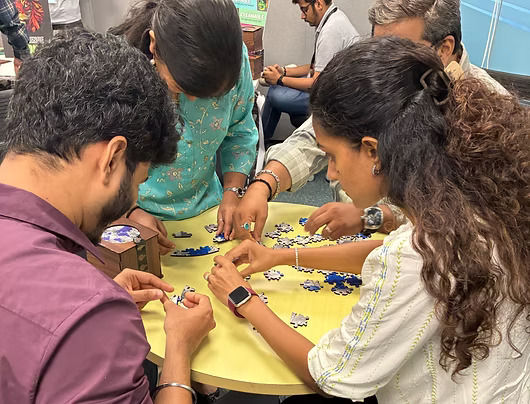
You can solve wooden puzzles alone when you want uninterrupted concentration, or put one on a table and let several people work through it together.
No complicated setup. No tutorial. Just pieces and a problem waiting to be solved.
Conclusion
The appeal of jigsaw puzzles for elders is not simply reaching the finished picture.
The real interest comes from searching, testing, rotating and reconsidering each decision.
Change the shape, artwork or difficulty and an old activity can feel completely unfamiliar again.
Sometimes, making the puzzle harder is exactly what keeps it interesting.
Explore jigsaw puzzles for elders at AdultJigsaw and find a level, artwork and challenge that gives your usual puzzle-solving strategy something new to figure out.
Citations
Frontiers in Aging Neuroscience – Jigsaw Puzzling Taps Multiple Cognitive Abilities: https://www.frontiersin.org/journals/aging-neuroscience/articles/10.3389/fnagi.2018.00299/full
PubMed – Jigsaw Puzzling and Visuospatial Cognition: https://pubmed.ncbi.nlm.nih.gov/30327598/
PubMed – Jigsaw Puzzles as Cognitive Enrichment (PACE): https://pubmed.ncbi.nlm.nih.gov/28877756/


Comments