
Circular Jigsaw Puzzles That Turn Familiar Rules Upside Down

Four corners.
Straight edges.
A picture to follow.
That's how most people approach a jigsaw puzzle.
But what happens when those familiar starting points disappear?
Suddenly, solving becomes less predictable and considerably more interesting.
That's the appeal of Circular Jigsaw Puzzles.
They challenge familiar habits, introduce unexpected piece arrangements, and invite you to look at puzzling from an entirely different perspective.
What Happens When a Puzzle Has No Corners?
Traditional rectangular puzzles often encourage an edge-first approach.
Circular designs change that routine.
Instead of relying on four corners, solvers must pay closer attention to visual patterns, colour transitions, and the relationships between individual pieces.
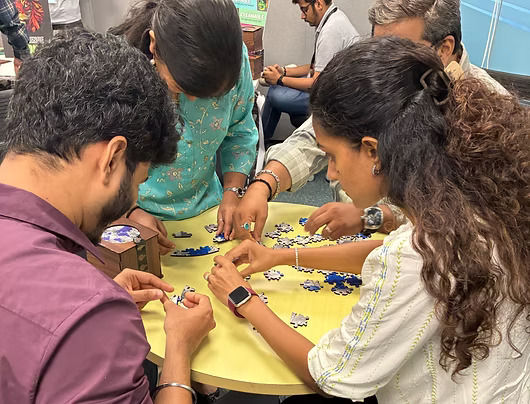
At Adult Jigsaw, CircZles introduces another unexpected element: hexagonal wooden pieces arranged into circular artwork.
The result is a puzzle that rewards observation rather than simply following familiar assembly habits.
Explore more solving approaches in our puzzle strategies guide.
Why Circular Jigsaw Puzzles Feel Different
The challenge isn't necessarily about having more pieces.
It's about understanding how those pieces connect.
Three elements make the experience distinctive:
Unfamiliar geometry: Hexagonal pieces encourage you to reconsider how shapes connect.
Visual exploration: Artwork, colour transitions, and repeating details become valuable clues.
Flexible starting points: Instead of beginning with corners, you can identify a striking feature and build around it.
These small changes create opportunities to experiment with different solving approaches.
And sometimes, the most satisfying discovery is realising that your original strategy needs changing.

The Science Behind the Solving Experience
Completing a jigsaw involves more than identifying matching colours.
That makes the activity an interesting combination of visual exploration and hands-on problem-solving.
The experience can be enjoyable without turning every puzzle session into a performance test.
Finding a Challenge That Matches Your Curiosity
Not every puzzle needs to be approached with the same strategy.
Some artwork offers clear colour boundaries.
Other designs require closer attention to subtle textures, repeated shapes, or intricate details.
When exploring Circular Jigsaw Puzzles, consider:
Artwork: Choose imagery that genuinely captures your attention.
Complexity: Select a challenge appropriate for your experience.
Solving style: Decide whether you want an unhurried session or a competitive challenge.
Replay value: Try solving the same design using a different starting point.
Discover the Introspective Collection for intricate artwork or browse wooden jigsaw puzzles to find your next challenge.
A Different Shape, A Different Perspective
Sometimes, changing the shape is enough to transform a familiar activity.
Without traditional corners or predictable piece arrangements, every decision becomes an opportunity to observe, experiment, and reconsider.
The finished artwork is satisfying, but discovering your way through the challenge is what makes the experience memorable.
Explore Adult Jigsaw's circular wooden puzzles and discover what happens when the familiar rules no longer apply.
Citations:
Jigsaw Puzzling Taps Multiple Cognitive Abilities and Is a Potential Protective Factor for Cognitive Aging:
https://www.frontiersin.org/journals/aging-neuroscience/articles/10.3389/fnagi.2018.00299/full
The Efficacy of Online Jigsaw Puzzling for Mental Well-Being in Older Adults: A Pilot Study:


Comments